And a savoy cabbage, of course.
Reports on the creation of an improvised comic book, and more... Pictures every Tuesday, Words every Blue Moon
Showing posts with label repetition. Show all posts
Tuesday, 6 October 2015
Ginger Root
Labels:
abstraction,
collage,
digital,
gimp,
kendal,
LICAF,
repetition
Monday, 24 August 2015
What Is Home ?
I'm very excited to lift the lid a little on a project that's been taking shape over the last couple of months. Lakes International Comic Arts Festival runs a Window Trail each year, in which artists are paired with local businesses, and get to decorate their window fronts in a way that reflect both the comics medium and the business itself.
This year, I've been paired with Kendal YWCA, who operate a Resource centre that includes a cafe and local business resources including a conference room. On the upper floor, Impact Housing Association - also collaborating on this exhibition - provide supported accommodation for young homeless people.
The cafe area has some big, impressive window frontage, with a beautiful curve of 10 panels across the front of the building, and several other full-length surfaces looking onto, and within, the public space of the cafe. It's the closest thing I've encountered in real, physical comics to an infinite canvas! You can see some of the big window in the photos below.
The display will be something between a comic strip, and abstract art installation and a crossword puzzle, readable from both the inside and outside.

For the subject matter, I've stuck with my improvisation approach, and sent out a questionnaire to the various participants in the building : office staff, residents, the cafe people, and small businesses who use the cafe facilities, getting their ideas on the topic of "home". And, as usual with my improv work, what a lot of interesting answers have come back.
A few (very preliminary) images below, that may end up in the exhibition. They aren't in any particular order here, and won't be arranged in 2x3 grids in their final form (and a few are without words for now). This might look like a lot of images, but it's still a small section of the final exhibition.
This year, I've been paired with Kendal YWCA, who operate a Resource centre that includes a cafe and local business resources including a conference room. On the upper floor, Impact Housing Association - also collaborating on this exhibition - provide supported accommodation for young homeless people.
The cafe area has some big, impressive window frontage, with a beautiful curve of 10 panels across the front of the building, and several other full-length surfaces looking onto, and within, the public space of the cafe. It's the closest thing I've encountered in real, physical comics to an infinite canvas! You can see some of the big window in the photos below.The display will be something between a comic strip, and abstract art installation and a crossword puzzle, readable from both the inside and outside.

Something like this ...
For the subject matter, I've stuck with my improvisation approach, and sent out a questionnaire to the various participants in the building : office staff, residents, the cafe people, and small businesses who use the cafe facilities, getting their ideas on the topic of "home". And, as usual with my improv work, what a lot of interesting answers have come back.
A few (very preliminary) images below, that may end up in the exhibition. They aren't in any particular order here, and won't be arranged in 2x3 grids in their final form (and a few are without words for now). This might look like a lot of images, but it's still a small section of the final exhibition.
This is, as ever, a collaborative work, with the actors from Kendal Community Theatre, and photography from Paul Want, Alan Walker, Julie Walker, Tim Hancock (and myself) all playing a big part.
Tuesday, 19 May 2015
What are the biggest problems in your life?
Labels:
announcement,
digital,
generated,
gimp,
improvisation,
kendal,
LICAF,
photoref,
repetition
Tuesday, 17 February 2015
Under the Radar
Totalitarian regimes often employ strong centralised censorship of media channels as a means of exercising control. It's interesting to note how often these operations develop blind spots to particular media, allowing some discourse against government ideas to filter through. The blind spots often develop around areas of humour or fantasy - seemingly pointing to a certain literal-mindedness or lack of imagination in the average dictator and his or her apparatus of control.
The most commonly cited example of this is the Soviet era's willingness to publish science fiction, such as Bulgakov's "Heart of a Dog" and the Strugatsky brothers' "Monday begins on Saturday", which offered thinly-veiled criticisms of the state. Not all subversive work escaped the censors - Yevgeny Zamyatin's "We" was largely circulated via underground channels, for example, but still many subjects could be broached because they were done so in disguise.
The example of this topic that we'll examine today is the syndicated cartoon strip "Feeling Lucky, Adventure Jim?", which appeared in the Ogopathian tabloid newspaper "Petelin", (literally "The Cockerel", but linked via various phrases to the concept of freedom) in the years immediately after the digital revolution known internally as The Encryption. As a state-registered publication, Petelin was watched closely by the Ministry of Information, and editorial and news content followed the party line. The curiously-titled "Adventure Jim" typically featured on the back page, and purported to inform citizens of the appropriate response to the new surveillance technologies that were being rolled out across the country. An early example does this in a rather straightforward fashion, although the somewhat clownish appearance of the eponymous hero strikes an odd note from the start.
Jim assures us that he is lucky, to have the support of the Ministry in thinking an acting like a citizen of the new regime.
Within a matter of weeks, the tone of the strip has changed somewhat, offering a range of rather disconcerting imagery, such as the representation of the state as a bowl of talking disinfectant:
Sufficient elements of the earlier strips, and of official party wording, are retained, but the juxtaposition of the phrase "emptiness is serenity" with Jim's look of outrage or horror tells us a lot about the cartoonist's sympathies, and his/her expectations as to what the largely automated censorship process will and won't pick up on. (The identity of "Buffalo" has never been firmly established, and, as has been noted elsewhere, the symbol of the Buffalo was co-opted by both the ruling committee and elements of the early resistance, based on the ambiguity of the nonsense sentence popularised by the jazz band The Overcoats in the years immediately prior to The Encryption.)
Having secured a few column inches out of the censor's watch, Buffalo appears to have placed a test strip that openly lampoons the earlier message:
Having got away with that, subsequent strips appear to offer veiled references to emerging technologies being developed by the Ministry of Information, and their deployment.
The nonsensical reference in the strapline message has been speculatively linked to the town of Cnoot, out of which a cell of resistance operated for some years. Further strips demonstrate awareness of the micro-sensors that were deployed in the third decade after encryption, and of the cottage industry of "tin foil hats" thought to guard against some of the Ministry's more intrusive systems.
It should be pointed out that the samples shown here illustrate the few examples of direct knowledge of Ministry activity, and that inbetween times, the strp would run for weeks in a rather more whimsical mode, developing the diverse cast of characters including the increasingly argumentative feet, and the singing bath tub. Whatever the nature of the elusive Buffalo, the strip ran for little more than two years before it was unceremoniously dropped, and most references to it within official documentation wiped.
In contrast to the slow-moving bureaucracy of the Soviet era, the censorship apparatus of post-Encryption Ogopathia was highly adaptive and innovative, and one can only assume that Jim's adventurous author soon found that his/her luck had run out.
Tuesday, 9 December 2014
Tuesday, 25 November 2014
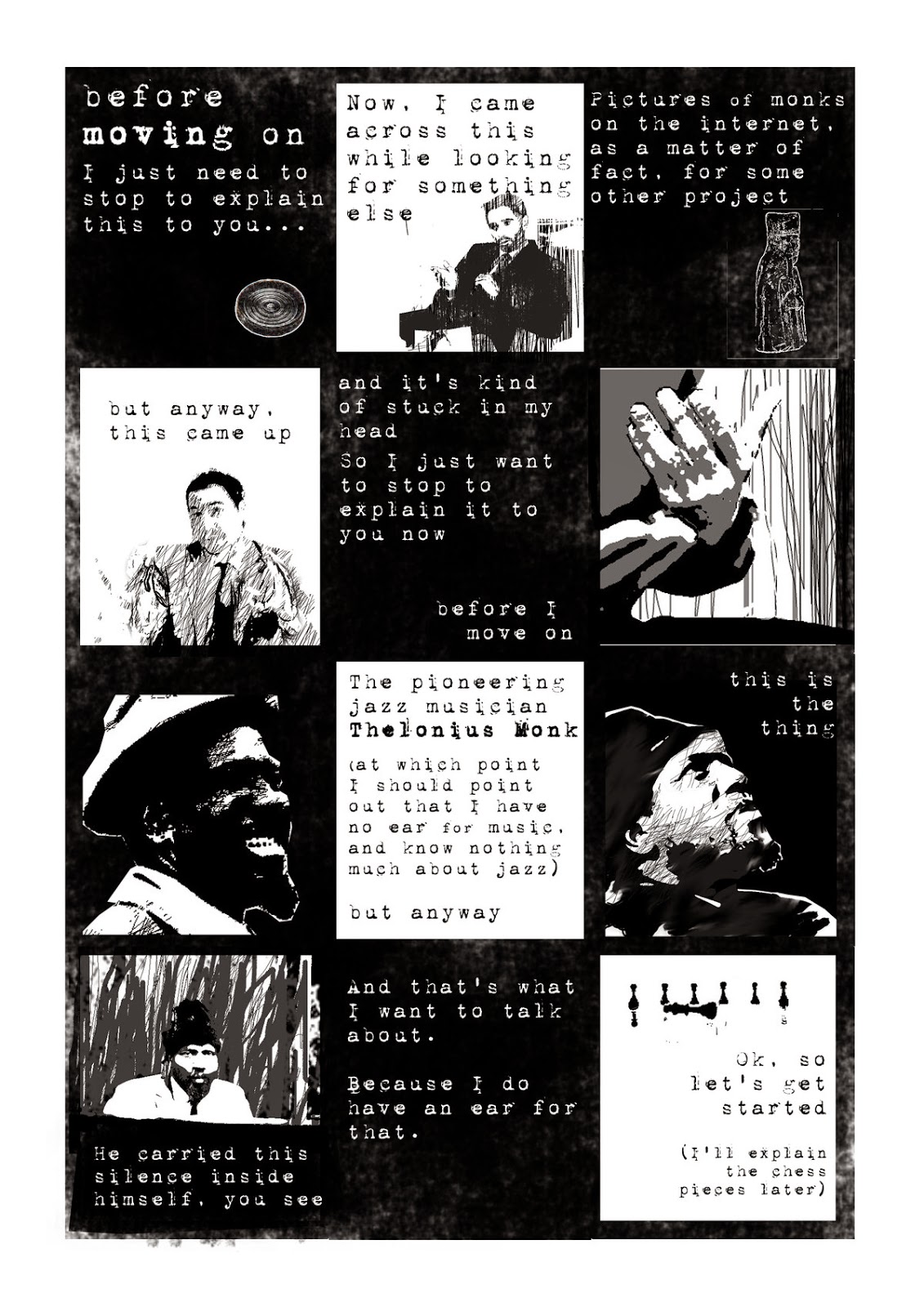
Before Moving On
Originally published in the first issue of the excellent Indie Comics Quarterly
I genuinely do know very little about Thelonius Monk, and stumbled upon his story online on wikipedia, while looking for visual refs for something else. The rest of the narrative descends quickly into fiction, though (or, at least, the narrative voice is no longer an account of my thoughts or feelings).
Tuesday, 18 November 2014
The Martians are coming!
Yet another unsplash email into my inbox... nothing deep this time, just funning around, and focussing on the dialog. Enjoy! Big thanks to Jonathan Velasquez Ramiro Checchi Sven Schlager davide ragusa (twice) Greg Shield Gabriel Santiago Kim Daniel Volkan Olmez for some really beautiful images to work with, and the cosmic Dr Mike 2000's sprawling saga Universe Gun, who's writing inspired the banter between the Chet & Sue characters in this strip.
Tuesday, 4 November 2014
Water Ways
Another Unsplash kata, using the images mailed 29 Feb. Trying to combine the words and pictures in less of a traditional comic-book way here.
Lots of pale, watery images this week, with the bright yellow of the tree standing out among them.
The canoe was the obvious narrative starting point here, and I "cheated" and did a bit of gimp-ing to remove the boys one by one. Leaving in the reflections started out as an accident, but it was a good one that serves the story well, I think!
Credits: Caleb George Taylor Leopold Silvestri Matteo Brownie Casey Fyfe (twice!) Caleb Thal Dustin Scarpitti Todd Quackenbush Matthew Clark
Labels:
complete strip,
digital,
gimp,
kata,
panel size,
repetition,
unsplash
Friday, 24 October 2014
Buffalo buffalo ... and so on
UPDATE: I have created the comic strip that explains this. Yes, diagrams do help to visualise it. But then things went a little strange... It'll be on the blog next Tuesday.
There's just one thing that I want to tell you today...
Buffalo buffalo Buffalo buffalo buffalo buffalo Buffalo buffalo
But you probably knew that already, right?
Full explanation here - it really is a sentence, with nouns, verbs, subject and object and all that.
Reading the explanation bamboozled me - I had to go through it several times before it made any sense to me. Which made me wonder whether it could be explained more easily in a comic.
The improvised Graphic Novel is going to be partly about information theory, I wonder if I can sneak a few buffalo in.
The image above is of Tibetan Yak, closest I could find in my sketchbook to Buffalo at short notice, I'm afraid. It's from a piece that I did a couple of years ago, called "The Bird Princess", that takes it's starting point with a fairly incomprehensible (to me) folk story from the Tibet/Nepal region, that touches on the process of westernisation that many parts of the world are undergoing, and the interweaving of modern and traditional ways of looking at the world. The pictures are a mixture of hand drawn, and stills captured from old public domain movies (with colours added by the ever-lovin' blue-eyed Gimp, of course). It's one of many strips in my new book (see sidebar)
Thursday, 23 October 2014
On the "Mainstream" in Comics
Literacy & A Laureate!
Last Friday, in Kendal, the Comics Literacy Awareness project was announced, and industry veteran / stalwart / good egg Dave Gibbons was crowned the first UK Comics Laureate. CLAw has quite a specific remit of encouraging the use of comics within the educational sector, to improve the literacy level of UK children through use of comics in schools, but it inevitably ties into the bigger discussion of whether comics are any good or not, and whether they're ready to crawl out of the ghetto they've been inhabiting. Certainly, David Barnett's piece in today's Guardian tackles that bigger question, with a list of Five must-read graphic novels that prove that comics are worthy of a laureate.I want to take issue with the premise of this article on a number of levels. To clarify, I want to take issue with it in order to help further the adoption of comics outside of the ghetto. And I have a positive suggestion to make at the end. I think it's great that CLAw exists, and that we have a laureate. I think it's great that mainstream press like the Guardian is reporting on it, and that this in itself is no longer as remarkable as it used to be. And I think it's great that Dave Gibbons has the job for the next two years - his acceptance speech oozed amiability, enthusiasm and energy. Bring it on.
The Ghetto
A word on the ghetto - I've mentioned it twice now, so let me make myself clear. I'm talking about the Superhero ghetto. Through some quirk of fate/history, the majority of comics have been about superheroes, people who have "special powers", wear lycra-like costumes, have secret identities, nick-names and fight crime. There's a marvellous variety of stories told within these conventions, and I don't intend to dismiss all superhero stories, but the near-monopoly exerted by a genre (superheroes) over a medium (comics) is deeply, utterly, profoundly - well, more than a little bit - strange. It's as if all TV detective stories featured detectives who were also chefs, had speech impediments, and were named after the signature vegetable that showed up in every meal they cooked, or all celebrity chef shows were filmed on the top of a tall building with a resident mime artist in attendance. After 50+ years of such a situation, we just might stop noticing that it's bizarre.(Ok, so I've just invented the two killer genres that the world never knew it needed, but don't run off and write your best-selling script yet, hear me out to the end of this article!)
So, the stated aim of Mr. Barnett's article is to prove that comics are ready for prime time (inasmuch as having a laureate indicates that), and he's trying to prove it to us by presenting a curated selection of five works.
I so, so want him to prove that point.
Yeah, here comes the "but"s. But four of the five are about superheroes. But one of them was being touted as the "get out of the ghetto" ticket in the late 1980's, and we've evidently made only limited headway. But what about books X, Y and Z, that are definitely in the top 5? (The comments section of his article is brimming with that last one!)
At the root of it, how can a list of any 5 comics make any headway? Can you name the five foods that will "cure" a fussy eater? The five herbaceous plants that will "make" any garden into a work of art? Even the five best writers or painters of the twentieth century?
And who are we trying to convince? The educational establishment? The readership of the Guardian? Society at large? Some shadow projected on the wall because we had a hard time reading comics as a teenager (hey, I've certainly got one of them)?
Audience
For the sake of argument, I'm going to define a target audience. They sometimes read books, watch films and TV, have other interests such as gardening, cycling, walking, sport, pets that consume some parts of their leisure time.Now, maybe this audience isn't to your tastes? Too narrow, maybe? Too posh? Too nice? No probs, they'll do for now, and what I'm going to say to them probably applies to your audience too.
If we look at the tastes in music, or TV, or books, or films, of this audience, it'll be all over the place. Classical to punk rock to death metal to jazz to easy listening to folk to reggae to pop. SAS confessionals to Aga sagas to gritty crime to quirky rom-com/chick-lit to metafiction to costume drama. Oh, and everything in between - I forgot about that.
So any list of five isn't going to hit a very big target within that group, as I grumped to Messrs Barnett, Gibbons and CLAw earlier today on twitter. So what can hit the mark? Well, Paul Gravett's given us a list of 1001, and a very fine list it is too, but it takes rather a long time to read, and therefore the drop-off rate is going to be quite high. Can we target things a bit better?
#comicequiv
So here's an experiment. On twitter, make a connection between a film, TV series or novel (or a director or author), and a comic (or graphic novel if you're feeling posh!), and word it like this:"If you like X then you might like Y #comicequiv". Two words in there are particularly important:
- "might" (because up to 50% of the time, we'll be wrong!)
- #comicequiv : that's a hashtag, a meaningless bit of interweb flotsam-y, jetsam-y metadata. Twitter knows how they work, and will allow all of us to track and collate posts with that tag on it. Nobody else is using that tag right now.
- If there's a longer review of the comic that you think is persuasive, stick in a link to that. Shout out to the comic writer AND the book author/film maker etc. You've got 140 characters to play with!
Does this make sense? If we build up a map of good comics based on tastes in other media, would that help CLAw, and Dave Gibbons, and writers like David Barnett in the mainstream press to get their message across in away that sticks?
Us
I want to have a look at a second target audience - the ones who I wrote this article for, the people who care passionately about comics and want to see them grow up big and strong. (I didn't write this for the readership of the Guardian, or for the people I'd like to persuade about how cool comics are.)The majority of us, the promoters of comics, are comic fans, and have grown up within the ghetto. We're steeped in the culture of comics, and therefore have a certain myopia. Whatever we grew up with as kids and teenagers is imprinted deep in our brains. I grew up on Marvel UK and 2000AD in the late '70's, Miller's Ronin, Simonson's Thor and Moore & Gibbons' Watchmen blew my socks off in the '80's, and Gaiman and McKean's early experiments & McCloud's "Understanding Comics" wowed me as a student in the early '90's. I've since gone on to discover all sorts of other amazing comics - Mattotti, Tan, Toppi, Peeters, Modan, Greenberg etc. etc. etc. - but somehow I'm not imprinted in the same way to works I've come across as an adult. Not that I think the stuff of the '80's is better, or even that I enjoy it more - far from it - but it's deep in my cultural make-up somewhere, and I'm therefore more prone to overlook it's faults. And therefore more likely to make a poor recommendation.
Nostalgia ain't what it used to be
B&Q is a large DIY chain store in the UK. They play piped music to their customers. I realised I had reached a certain age, in the late 90's, when I went into the store and they were playing popular schlock from my teenage years - the sort of music that I wouldn't touch with a barge-pole. Wham!, Duran Duran, that sort of thing. And, before my cultural censor kicked in, I felt a thrill of recognition. We are imprinted by all sorts of things. I wouldn't expect someone not growing up in the '80's to be moved by the same music, nor someone who didn't read 2000AD aged 8 to be completely excited by Ron Smith's rubbery Mega-Citizens or Ezquerra's "Stainless Steel Rat" as I still am. Nostalgia does weird things to us. I raise it now, because reading through the many comments on David Barnett's article that suggest an alternative "obvious" contender, I think the majority are driven by nostalgia. It's as powerful as a kick to the head, and - get this - utterly impossible to communicate to someone who wasn't there.(I think the big two publishers understand nostalgia quite well, in the way they sell more to their existing, ageing audiences, rather than broadening the audience out.)
Case in point: I remember trying to convince a non-comic-fan friend that comics were cool (this was a while ago). I picked Morrison & McKean's "Arkham Asylum" as the then=pinnacle of the medium, with it's gorgeous multi-layered artwork and symbolically-dense script, that was inextricably tied in my head to the two non-superhero plays Morrison had brought the Edinburgh Fringe with Oxygen House theatre. I watched my friend read it, with a creeping realisation that they didn't have the in-depth knowledge of second-tier batman villains - Mad Hatter, Scarecrow, Killer Croc - required to even have a clue what was going on. Bad choice, my myopic nostalgia and acclimatisation to life in the ghetto. They were not convinced.
When making a recommendation now, I try to bear nostalgia in mind.
There, that's all. Let's get tweeting!
Tuesday, 21 October 2014
Tea Bag Ceremony
Another exercise using the curated selection of images from free stock image service unsplash.com, which they email out every ten days. Howto weave these random (and rather good) images into a narrative, given that our brains are hardwired to look for narrative in any sequence of images.
I felt lucky to get a couple of people in this week's selection, and, even better, more than one image of each of them. Just to be clear, the insults on p.4 are an ironical reflection on the calm voice of the narrator, nothing to do with the models!!
There's a seductive sense of authority to the "documentary" narrative voice, even when it's talking gibberish. One mis-step can make the presence of the voice jump back into the foreground.
Image Credits: Paula Vermeulen Noe Araujo Jan Erik Caroline Gutman mr.lee Jake Givens
Thursday, 16 October 2014
Improvised Comics - Getting There - A Local Handy Reference Map
Because we love you all! Simply print off onto an improbably-sized roll of paper, and stumble about the High Street of Kendal apologising to those you bump into or knock over as you trp over the tail end of this useful "little" map.
See you all tomorrow!
Labels:
announcement,
collage,
digital,
kendal,
LICAF,
repetition
Sunday, 5 October 2014
Nostalgia
A quick kata, following this recipe:
- take a weekly email from the excellent Unsplash.com
- Download all the pictures into Gimp
- Rearrange into a short story (no need to use every image, but extra marks for using most)
I'll be practicing this one regularly here, I think. I enjoyed the repetition of images here, the ambiguity, and the shift in authorial voice between p1 and pp2-4.
Good luck to Maurice and the narrator, whoever they are - here's to a non-violent resolution over a cup of tea!
Credits for Pictures:
Amanda Sandlin, Jacob Walti, Tanvi Malik, Desi Mendoza, Maciej Serafinowic, Gabriel Santiago, Steven Lewis, Mia Di Domenico, Joshua Earle
Labels:
complete strip,
digital,
gimp,
improvisation,
kata,
repetition,
unsplash
Subscribe to:
Posts (Atom)