Sunday, 4 January 2015

Trying Something New

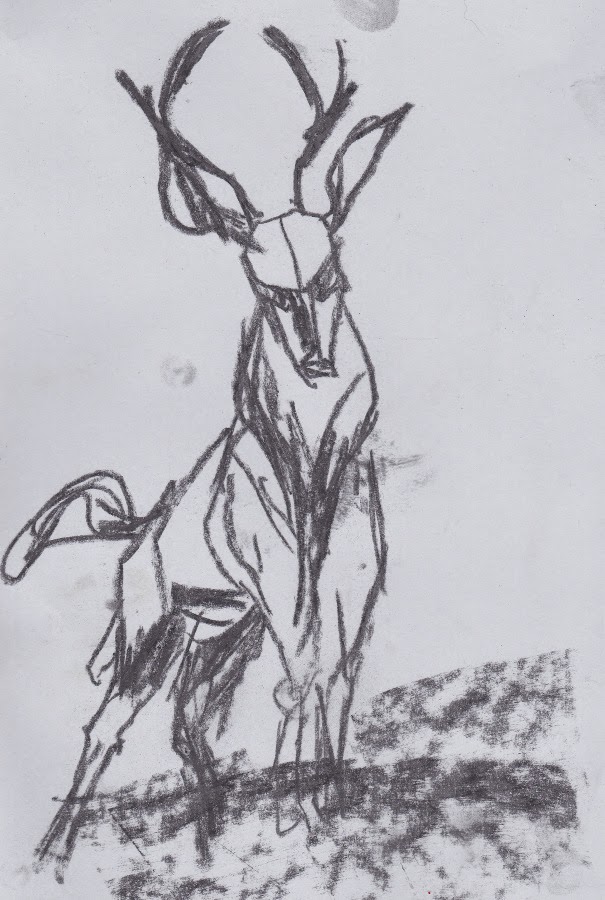
A few sketches here trying ut a new christmas present of some derwent XL graphite blocks - solid little bricks of crumbly, dusty graphite with a int of pigment thrown in, about 1.5 x 1.5 x 4cm. Impossible to use without getting your hands filthy - yes that paper started out white! - but very easy to wash off!

The sketches are taken from an old present - the Dover reprint of Ken Hultgren's "How to draw animals", originally published in 1951. Fabulous easy-to-read account of animal anatomy and posture (and how to use it to convey emotion) from one of Disney's storyboarders/artists of the 1940's (worked on Bambi).

I did these purely for fun, less than a few minutes each, a great warm up exercise, and good to be trying something well outside my usual style and materials.


Friday, 2 January 2015

Myths, Dreams and When The Robots Take Over

Myths and Fairy Tales (or Wonder Tales, as the Germans know them) occupy a powerful place in a culture's psyche, and can offer a deep and direct view into it's heart.

Grimm's tales describe a timeless, archetypal view of the human condition, but also a powerful vision of life in Europe during the "Dark Ages" (hunger, famine, poverty and feudalism) and further back into our primitive past (wolves, forests).

Modern "urban myths" offer archetypal insights into the alienation and loneliness of our modern world - the animal side of ourselves that we repress as crocodiles and budgies breeding in the sewers, our self-hatred and vulnerablity in a social vacuum in many variants of the serial killer myths.

Ancient myths and modern ones can sometimes combine in unaccountably gruesome and beautiful ways under the extreme pressures that the disaffected people of the world live under. (If you're going to follow that link above, give yourself time, and space, to absorb it. I've read few accounts of such hope and hopelessness, it makes me weep. One day, I'd like to do something with it, but that's for another day.)

There's a myth doing the rounds at the moment, with the support of such luminaries as Elon Musk, Stephen Hawking and several up and coming movies (with various degrees of intelligence, I might add!) The story that we're busy telling ourselves around the digital campfire is that artificial intelligence is going to develop unpredictably quickly, bootstrapping itself to the point where it overshoots our own faculties faster than we can react.

On a pessimistic note, I can't say that I find our collective reaction time to existential threats to be very fast. If global warming's anything to go by, I'd advise AI to take it's own sweet time at overshooting us. We'll still be tripping over influential "skeptics" as they hop in and out of bed with vested interests, while politicians cook up hamstrung, half-baked non-solutions long after the point of no return. But I digress.

I'm interested in why these stories have so much traction right now. I doubt it has very much to do with us being near a tipping point in the emergence of AI. I suspect that we're using fiction to talk about the present, as I wrote about in last week's blog. The robots are a metaphor, but for what?

Humanity being subjugated by large, rapidly expanding non-human entities that can collectively out-think, out-manoeuvre us, and couldn't give a toss whether we live or die. Why does that strike a chord with us, here and now?

Look around. I could throw in a few suggestive words at this point, like multi-national corporation, government, banking crisis, and post-Snowdon era. But that's just my take on the story. What's yours?

Friday, 26 December 2014

On Genre, Fantasy and Reality

The Valkyries put out a great question on twitter the other day, to which I made a facetious reply, as you do:
but it got me thinking about genre. I do have a fairly fixed idea about the kind of stuff I like to read (comics/novels), watch (films/TV) and otherwise consume (edible food-sagas/olfactory novels) and so on. Oh, and to write - in general, like many writers, I like to write the sort of stories that I'd like to read. I wonder if that's universal...

And it does exclude superheroes. And straightforward genre sci-fi. And straightforward cod-medieval high fantasy. I'm not a big fan of kitchen sink realism either, I like stuff with an element of the bizarre or supernatural mixed in with real-world concerns, whether political, psychological or whatever other form of serious. For a long time I've been quite comfortable with the term "magical realism". Recently I discovered the term transrealism, coined by Rudy Rucker in 1983, and recently revived by an article by Damien Walters in The Guardian. And I felt quite comfortable with that label too.

And I've felt quite proud of my stance. 

The two danger words here are, of course, "comfortable" and "proud". Pride comes before a fall, and comfortable comes before an armchair, or pair of slippers usually. Either word signifies a lack of original thought.

To quote from the blurb on the back of my book Myths of this World (available from Lulu in a range of formats to suit all pockets, shelves, devices and budgets):

"This is not a collection of folk tales, but modern short stories taking folk tales, myths and legends as a starting point. I hope they challenge you, change you and enrich your life in some way." 

I've no wish to plough the same furrow with my new improvised work, and so I've been deliberating the exact nature of that story while preparing art from the photoshoots in Kendal a few months back. Without deviating from the magical realism formula (although there's been plenty of hesitation!). The Valkyries question prompted me to question this stance, to challenge myself. Why am I using fantastical devices in my stories? Why am I also striving for realism, for some sort of political/moral "edge"? 

At one level, I'm trying to replicate that "a-ha" moment, that comes when the fantastic and real elements of a story meet. When Ofelia is shot by her step-father in del Toro's "Pan's Labyrinth", fulfilling the rules of her inner fantasy world and the reality of 1940's Spain's descent into fascism. The revelation tin Carey's "My Life as a Fake" that Christopher Chubb's arrival in Singapore in a genie-like cloud was down to dry ice used to store some medicine, for the inexplicably fictional-but-real, and dying, Bob McCorkle. The mingling of post-nuclear apocalypse and gnostic mystery in Hoban's "Riddley Walker". The magical worlds throw light on the real world, reflect it back at us in an unfamiliar way, that makes us see things afresh. And the presence of the real shows up the cracks in the fantasy, the contradictions and failings of those beautiful escape-pod worlds.

I'm pursuing a political agenda too. I want to speak about injustices that I perceive in this world, and fiction is a recognised and effective way of doing that. Without having to pursue a career in politics - bonus! The world we're inhabiting is so strange, fantastical and fluid, that fantastic fiction seems like the best kind of fiction to address it.

There's something else too, though. Throwing fantasy and reality together like oil and water, the two don't mix. A work of fiction in which the author knows what they want to say, and construct a set of symbols and meanings which say exactly that, no more or less, is a poor piece of art. The world is not neat, does not make sense, does not fit in the box. Using two diametrically opposed genres at once is a way of opening up to the ambiguity. Good fiction challenges the reader, rather than providing / imposing a pat set of answers. 

I don't know whether Ofelia "won" at the end of Pan's Labyrinth, and that's not important. Chewing over the ending, I've noticed that she really did save her little brother, that the brutal, unimaginative Captain Vidal was also constructing stories (around the broken pocketwatches), that the fantasy king and queen are depicted as passive and out of reach, and so on. 

I don't know why the invented Bob McCorkle came to life, and why he was dying. Or why he was a better poet than his creator. Whether all the years of waiting and bloodshed over a handful of manuscripts was worth the effort in the end.

I don't know whether Riddley Walker is bleak or hopeful.

It's a bit like life, isn't it?!

But anyway, I knew all that before considering the Valkyies' challenge. That was my comfortably held opinion on the matter.

I'm now asking myself which matters most to me, the lack of closure, the ability to talk politics, or the sheer beauty of watching oil and water mix. And can I only achieve my aim using this particular combination of oil and water.

After all, aren't all comics oil and water - mixing the words and pictures together imperfectly, never quite dissolving in one another, never quite making perfect sense? 

I don't know the answer to the questions I'm asking, and that makes me feel a bit giddy!

Tuesday, 23 December 2014

Improvised Comics Art

No full strip this week, as I'm trying to focus on the BigWork (something about the 2-month anniversary of LICAF whizzing by...)

Enjoy! More on the way next week.


Tuesday, 16 December 2014

The Pig Man and Fish Man

As a side project, I've been playing about with a computer program for generating comic strips. I posted some first examples a while ago, using randomly selected images.

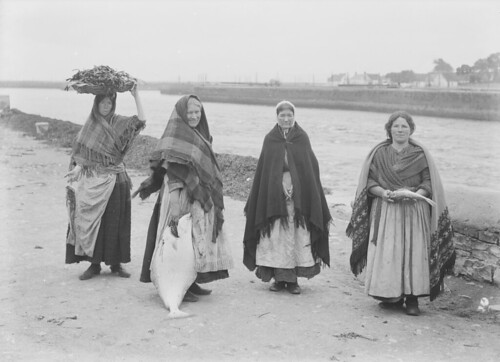
The program still doesn't do much, but it now talks to Flickr, the online photo sharing service, and fetches pictures who's keywords match words in the accompanying sentence (picking ones with a high "interestingness" rating). Some semblance of meaning carries over from the words to the pictures, some of the time - and the repetition of images is interesting (especially the rat poison one). I don't think us humans have much to worry about yet, though - the story's carrying most of the work here, and that's entirely human-generated.

Stay tuned, as I keep tuning the engine! And check out a similar project by Greg Borenstein, The Generated Detective - he's got a bit further along a similar path, I think, and his semi-automated word generator balances the weight between the words and pictures nicely.


The Pig Man and Fish Man


I always preferred the Pig Man to the Fish Man.

He came round less frequently, and he was scarier.

This was when I was little.

The fish man just sat in his van.

Waiting for Mother to come out and buy his wares.

He looked like he was asleep.

Het from next door said one side of him was asleep at any time.

But she was wrong

That was sharks. Not fish.


The Pig Man would creep up on us,

When we were out playing in the mud.

First thing, usually, was his laugh.

Big and dirty and rough.


He’d ask us if we’d been naughty

And give us interesting things to play with.

Boxes of matches

Rat poison pellets


That sort of thing.

“Look sharp, men”, he’d say, “Mother’s coming”

And he’d put on a pious face, then

And tell her what good little kids we were.


I remember her buying clothes pegs from him

There must have been other things too

But it’s the clothes pegs I remember


He stopped coming after I was so old

Het said he’d been sent to prison


I carried one of those pegs in my pocket for years after

Mothers pegs - I knew they were mine really

Rubbing it for good luck, and saying “Now then, Men”

When things got a bit difficult

Tuesday, 9 December 2014

Celestial Music

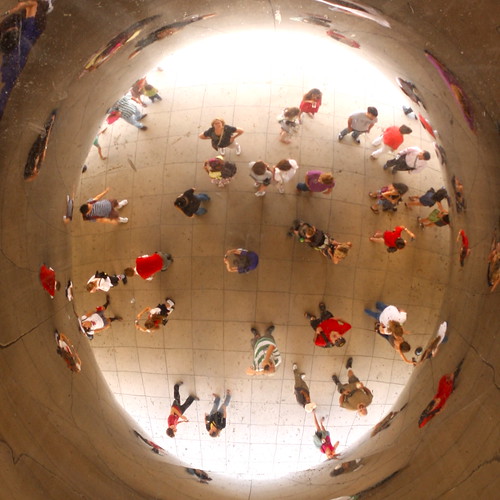
Work in progress on some photo-compositions using images by my collaborator Paul Want. These will be used o explain the influence of gravity on planetary bodies (honest!) The people doing acrobats with the water-spraying chair-hoop-thing are Circus Katoen, who were performing at Mintfest in August 2014


Divide: part 2

Picking up where last week's story left off...