from the book/exhibition "What is Home ?"
Reports on the creation of an improvised comic book, and more... Pictures every Tuesday, Words every Blue Moon
Showing posts with label formalism. Show all posts
Tuesday, 10 November 2015
Worlds
Labels:
digital,
formalism,
gimp,
improvisation,
kendal,
LICAF,
what_is_home
Tuesday, 13 October 2015
Monday, 24 August 2015
What Is Home ?
I'm very excited to lift the lid a little on a project that's been taking shape over the last couple of months. Lakes International Comic Arts Festival runs a Window Trail each year, in which artists are paired with local businesses, and get to decorate their window fronts in a way that reflect both the comics medium and the business itself.
This year, I've been paired with Kendal YWCA, who operate a Resource centre that includes a cafe and local business resources including a conference room. On the upper floor, Impact Housing Association - also collaborating on this exhibition - provide supported accommodation for young homeless people.
The cafe area has some big, impressive window frontage, with a beautiful curve of 10 panels across the front of the building, and several other full-length surfaces looking onto, and within, the public space of the cafe. It's the closest thing I've encountered in real, physical comics to an infinite canvas! You can see some of the big window in the photos below.
The display will be something between a comic strip, and abstract art installation and a crossword puzzle, readable from both the inside and outside.

For the subject matter, I've stuck with my improvisation approach, and sent out a questionnaire to the various participants in the building : office staff, residents, the cafe people, and small businesses who use the cafe facilities, getting their ideas on the topic of "home". And, as usual with my improv work, what a lot of interesting answers have come back.
A few (very preliminary) images below, that may end up in the exhibition. They aren't in any particular order here, and won't be arranged in 2x3 grids in their final form (and a few are without words for now). This might look like a lot of images, but it's still a small section of the final exhibition.
This year, I've been paired with Kendal YWCA, who operate a Resource centre that includes a cafe and local business resources including a conference room. On the upper floor, Impact Housing Association - also collaborating on this exhibition - provide supported accommodation for young homeless people.
The cafe area has some big, impressive window frontage, with a beautiful curve of 10 panels across the front of the building, and several other full-length surfaces looking onto, and within, the public space of the cafe. It's the closest thing I've encountered in real, physical comics to an infinite canvas! You can see some of the big window in the photos below.The display will be something between a comic strip, and abstract art installation and a crossword puzzle, readable from both the inside and outside.

Something like this ...
For the subject matter, I've stuck with my improvisation approach, and sent out a questionnaire to the various participants in the building : office staff, residents, the cafe people, and small businesses who use the cafe facilities, getting their ideas on the topic of "home". And, as usual with my improv work, what a lot of interesting answers have come back.
A few (very preliminary) images below, that may end up in the exhibition. They aren't in any particular order here, and won't be arranged in 2x3 grids in their final form (and a few are without words for now). This might look like a lot of images, but it's still a small section of the final exhibition.
This is, as ever, a collaborative work, with the actors from Kendal Community Theatre, and photography from Paul Want, Alan Walker, Julie Walker, Tim Hancock (and myself) all playing a big part.
Tuesday, 28 July 2015
Ode to Socks
A poem by Pablo Neruda, illustrated with images by Paul Klee, whose work is perfectly suited for this kind of thing. All I did was stick the two together.
Tuesday, 23 June 2015
What can we tell the trees?
Work in progress on a strip "What can we tell the trees?", the title being a loose riff on something else I did a while back.
Loosely, part of the Kendal improv series. At last year's Lakes Festival, I decided on the spur of the moment to ask Stephen Holland of Page45 if I could film his excellent talk on selling comics, to use as material for a strip. Thanks, Stephen!
(Page45 is a comic shop in Nottingham, and one of the best voices in the UK comics scene, promoting a far wider range of material than just the usual superhero fair. If you don't live in the area, you can still buy from them via their comixology storefront. This is not an ad, by the way, just a genuine recommendation.)
Tech note, because of that white jacket, and a dark background, the usual cross-hatching technique didn't work well, so I tried something different - which is always good.
Loosely, part of the Kendal improv series. At last year's Lakes Festival, I decided on the spur of the moment to ask Stephen Holland of Page45 if I could film his excellent talk on selling comics, to use as material for a strip. Thanks, Stephen!
(Page45 is a comic shop in Nottingham, and one of the best voices in the UK comics scene, promoting a far wider range of material than just the usual superhero fair. If you don't live in the area, you can still buy from them via their comixology storefront. This is not an ad, by the way, just a genuine recommendation.)
Tech note, because of that white jacket, and a dark background, the usual cross-hatching technique didn't work well, so I tried something different - which is always good.
Tuesday, 16 June 2015
Thursday, 9 April 2015
Who Makes Art?
Unreviewed along the way in this article:
What is Art? It's a huge question with very little boundary or frame of reference. In fact, it's massive - it has no edges whatsoever. So, I'm going to sidestep it altogether here, and look at something much more tractable. Who makes art, and why?
Our society generally subscribes to the myth of the Lone Artist - a special individual with a unique vision that they need to impart to the world. And having subscribed to that idea, we see what we want to see, even when reality is otherwise. Even our publishing institutions get stuck in this way of seeing things - as Sarah McIntyre's recent writings and campaigning on the treatment of illustrators ably demonstrates.
Art can indeed be made by remarkable individuals, or even by collaborations between small huddles of remarkable individuals such as a writer and an illustrator, but even that isn't the only model.
Art can often work when it reaches out beyond the originators' own concerns, to touch a wider audience. Good art often works by requiring audience participation, letting the reader/viewer/imbiber (you are au fait with these new edible comics, aren't you? they're all the rage!) bring something to the table, to actively engage in the experience. A bit of ambiguity or open-endedness can be very satisfying - recent examples I've come across in comics include Rutu Modan's Exit Wounds, Oscar Zarate's The Park and Rob Davis' The Motherless Oven - all of which leave the reader guessing as to what happens after the story's finished. In the case of "Exit Wounds", a fraction of a second after the story finishes, as we leave the protagonist jumping/falling out of a tree. In the case of The Park, even the parting symbolism is ambiguous - are we looking at a heart, or a broken heart? Either could be very apposite, depending on how the conversation we've just drifted away from concludes.
One can go one step further, and engage with the audience during the creation of a work. Surrendering control early on in the creative process can be a remarkable experience. The Applied Cartooning Manifesto is certainly an eye-opening read, pointing to uses of cartooning in service to the community, as well as to the inner artist. The Dawn of the Unread project, which released it's final section yesterday, is a great example of this, harnessing a diverse collection of creators in the service of public libraries (which perform a great service to us all), in a completely bananas, un-po-faced way (head on over to their site for details: in a nutshell, famous figures from Nottingham's history rise from the dead to stalk the streets in search of boooksss!) There are a number of stories, covering quite a range of styles, and a variety of local characters including thieves, preachers and of course, being Nottingham, Robin Hood. It's all available to read online, at the link above.
Community-driven art projects like this de-emphasise the role of the individual artist, but I don't think they diminish them - when an artist engages with the community, something quite powerful can happen. Joe Sacco, Daryl Cunningham, "Bad Doctor" Iwan Williams and Ravi Thornton all spring to mind.
(Quick aside and plug: this has been my own experience with the work I've done with Kendal Community Theatre at the Lakes Festival last year, in improvising a photo comic strip. I decided that I had to surrender control before I met the theatre crew and photographers, and arrive without a clear storyline or plot, just a bag of themes and ideas to get things started. It's been eye-opening, and really helped me grow as an artist. Watching key episodes in the story I'm creating unfold from the antics of a teenager, a middle aged person and an older person, for example, has been way better than pulling things out of my on creative pipe. I'll write more about the process of that project some other time - back to the topic at hand now...)
I've been sitting on this article for a week or so, and have come back several times with further examples of creative work that wasn't undertaken by a lone heroic artist. In the interests of space and time, I'll just list them here:
1. Tribal art e.g. Australian aboriginal art. This has become quite collectible in the international art world in the last few decades, but the art world really has struggled with the concept that the art isn't the product of an individual, but of the community, the language group, and spiritual traditions.
2. Loveable graffiti-ist Banksy's work has become collectible in spite of the fact that it's often rooted to large immovable structures, and he's had quite a bit of fun with the fact that he's anonymous and an art-world celeb, and blurs the line between vandal and high artist.
3. Lennon & McCartney published all their songs for the Beatles as co-written. There's an endless fascination with dissecting these, figuring out who "really" wrote which ones. Does it really matter?
4. 1930's mathematician Nicholas Bourbaki was actually a pseudonym for a group of well over a dozen mathematicians, writing collectively about Set theory (and yes, I'll argue interminably that maths is at least partly a creative venture!)
5. Cut-up and repurposing of old art in new forms can be powerful. Pioneered by the surrealists (Max Ernst's Week of Kindness is a good comics-related example!), this has made it's way into fairly mainstream culture with, for example Steve Martin's (and Carl Reiner's, and Rachel Ward's, and many others...) Dead Men Don't wear Plaid. Often still the work of one or two auteurs, drawing on older material from previous creatives takes the artist outside themselves, and brings in other influences.
6. Digitally-generated narratives such as Greg Borenstein's Generated Detective take the cut-up approach of injecting random outside influences a step further, by surrendering control of the elements of the art to a computer-driven algorithm. (I've dabbled with this too, FWIW, although it appears not to have aged very well, with several panels since being removed from Flickr!)
7. Karrie Fransman's comic book experiment The Death of the Artist is a collaborative piece of work between five artists, each telling part of a true story - in radically different styles - that involves them all as protagonists. Or is it? Or (...wait for it...) is it?!
I'm going to take a detour into Fransman's work at this point, and look at it in a bit more detail. Trust me, by the time I'm done, I'll be back on-topic. (Oh, and the next road sign reads "spoilers ahead", I think that's part of internet etiquette these days, isn't it?)
The Death of the Artist is a contentious, polarising book. Gut reaction first - I didn't enjoy reading it, I didn't like the characters, with their petty self-absorptions, artistic pretensions and back-biting. In the final chapter, with Vincent's death, something big and portentous has happened in their lives, and it doesn't seem to be processed by any of them properly. Along the way, drugs are consumed, casual hook-ups are had, and they wallow in their own unpleasantness. After the first reading, I was scrabbling for some connections between the pieces, wondering what they all made of each other after telling their stories, whether they'd moved on at all from that overarching point of view that life ends in your mid-twenties, that responsibility and creativity are mortal enemies. I wondered why it had been written, why only one of the five contributors had her name on the front ("and friends"), what the royalty split was, what the owners of the cottage (who are named) would think about the debauchery going on at their place, and so on. My buttons were well and truly pushed, and I realised that I was really enjoying the awful spectacle of it, and the grubby little feeling of superiority! So I went off to wash the dishes until I got over it.
A couple of weeks or so rolled by, and Richard Bruton's excellent review of the book came out, and got me seriously wondering whether the five characters were real. I'm tempted to say the other four - Karrie Fransman's real, she does courses for the Guardian, and I watched her very good TEDx talk on youtube a while back, before getting the book. But I've also read an interview with a couple of the other protagonists in it - they fight amongst themselves rather realistically, don't they, but it's almost too neat? And there's no reason that the real Karrie Fransman is the character called Karrie Fransman depicted in the book - Paul Auster's played that game before, and I doubt he's the only one. Coleridge blurred the lines between fiction and reality in the Rime of the Ancient Mariner's original introduction. Italo Calvino and John Fowles played cat and mouse games with the reader in some of their writings (and if you like horror, check out Emily Carroll's XXXX industrial-strength-fourth-wall-breaking scary story in Frontier #6, which made me switch on the night light at night for a couple of days after reading it, I'm not ashamed to say!) Borges wrote fiction under all kinds of disguises - encyclopedia entries, accounts of dreams, even book reviews (so watch out!!)
So if they're not real people, what's going on? Bad stuff's happened by the end of the story - whatever I might think of Karrie and co, they've lost a friend, and could have maybe done something to stop that happening - and that's a hell of a lot to deal with, and there are hints that they realise this. Is the book a cathartic re-working of traumatic events into something else? Like that mega-button-pushing epicentre of modern art controversy, Tracey Emin's bed (which I do not hold in high regard, for what little that matters), is this a bold reinterpretation of the artist's shortcomings and human failings, a refusal to dress life up with a civilised or aesthetic veneer?
And of course, the portrayals in the book are not completely real people, they're marks and cut-out photos on paper, with word bubbles in their mouths. The presence of an editor, shaping what is presented, is evident. Are we being invited to consider the real nature of art, to look at the multitude of hinges and mirrors that get in the way of someone else trying to communicate their experience, even when it's as warts-n-all as this? Is the apparent naivete and self-absorption calculated to get a response, and, if so, to what extent can they (or the "she" behind the fictional "they", if that's the case) really see beyond it? As a forty-odd year old, can I recall how I felt about life in my late twenties? Did I understand the balance between responsibility and creativity in the way I do now? What will I see when I'm sixty?
For an unlikeable, flimsy piece of work, it sure raises a lot of interesting questions! And they don't come easy, I feel like I'm having to do a lot of work to pull them out. Am I just a lazy reader, who prefers to be spoon-fed my profundity?
This is the point where we rejoin the main road. (If every book review followed a car journey metaphor, things would flow more smoothly altogether, in a roundabout sort of way.) By goading the reader into taking their own baggage with them, is Karrie Fransman reaching out to her audience, so that each reader experiences the work differently? Is surrender of the aesthetic polish a necessity to achieving this? Is this, in fact, a valid kind of community art?
I really don't know. From the way I've couched the questions above, it undoubtedly is. To the extent that it focuses so heavily on the role of the artist, and subscribes to the myth of the Lone Artist as Special Person, then no, I don't think it is. For my money, art about art is often narrow and exclusive - I know many interesting people for whom artistic aspirations/status are really not an issue, and, while I enjoy the company of other artists, I wouldn't want to limit the reach of my own work just to that circle. Given this book's ephemeral nature, I don't think it can be pinned down as exclusively reaching out or looking inwards. Can it only achieve this ambiguity by being so insubstantial? Is less more? - another big unanswerable question.
So I was going to leave it at that when another thought occurred to me. It's none of the above, it's a colouring book. On closer inspection, a lot of the pages are already coloured in, and the paper's quite shiny - my crayons had trouble taking to it. So, maybe not - I had to rethink. Slumped across my desk in an etch-a-sketch induced stupour, the real answer came to me. It's actually a puzzle book.
A quick search on TripAdvisor combined with google maps brings up the exact location of "Ben" and "Nicky"'s house in the Peak District, cross-reference those with the positions of the local millstone grit features known as "The one-eyed Welshman" and "The Hags", and we get a triangle some 30km along each edge. Overlaying the mirror image of the (quite literally) painted lady in the photo story on the map, lining up her eyes and nose with the boundary fence of the pub with the same name, highlights a particular spot in a nearby field. Fortunately, it's quite close to the home of my long-standing friend Maddy Updike. I gave her a call with the information above this morning, and her two sons went up there with their shovels and unearthed a marvellous golden terrier, on the side of which was inscribed the real meaning of the book. But I had my fingers crossed when I read it, so it made no sense. Do I get my five pounds now?
Confound it, if I'm going to get any sense out of this book, I'll have to put some work into it, so I might as well have some fun getting there!
- The Death of the Artist by Karrie Fransman
- The Dawn of the Unread project
- Frontier #6 by Emily Carroll
- Exit Wounds by Rutu modan
- The Park by Oscar Zarate
- The Motherless Oven by Rob Davis (again! I like this one)
- The Applied Cartooning Manifesto by The Centre for Cartoon Studies
- The Generated Detective by Greg Borenstein
- Six Word Story by Ernest Hemingway (and others)
What is Art? It's a huge question with very little boundary or frame of reference. In fact, it's massive - it has no edges whatsoever. So, I'm going to sidestep it altogether here, and look at something much more tractable. Who makes art, and why?
Our society generally subscribes to the myth of the Lone Artist - a special individual with a unique vision that they need to impart to the world. And having subscribed to that idea, we see what we want to see, even when reality is otherwise. Even our publishing institutions get stuck in this way of seeing things - as Sarah McIntyre's recent writings and campaigning on the treatment of illustrators ably demonstrates.
Art can indeed be made by remarkable individuals, or even by collaborations between small huddles of remarkable individuals such as a writer and an illustrator, but even that isn't the only model.
Art can often work when it reaches out beyond the originators' own concerns, to touch a wider audience. Good art often works by requiring audience participation, letting the reader/viewer/imbiber (you are au fait with these new edible comics, aren't you? they're all the rage!) bring something to the table, to actively engage in the experience. A bit of ambiguity or open-endedness can be very satisfying - recent examples I've come across in comics include Rutu Modan's Exit Wounds, Oscar Zarate's The Park and Rob Davis' The Motherless Oven - all of which leave the reader guessing as to what happens after the story's finished. In the case of "Exit Wounds", a fraction of a second after the story finishes, as we leave the protagonist jumping/falling out of a tree. In the case of The Park, even the parting symbolism is ambiguous - are we looking at a heart, or a broken heart? Either could be very apposite, depending on how the conversation we've just drifted away from concludes.
One can go one step further, and engage with the audience during the creation of a work. Surrendering control early on in the creative process can be a remarkable experience. The Applied Cartooning Manifesto is certainly an eye-opening read, pointing to uses of cartooning in service to the community, as well as to the inner artist. The Dawn of the Unread project, which released it's final section yesterday, is a great example of this, harnessing a diverse collection of creators in the service of public libraries (which perform a great service to us all), in a completely bananas, un-po-faced way (head on over to their site for details: in a nutshell, famous figures from Nottingham's history rise from the dead to stalk the streets in search of boooksss!) There are a number of stories, covering quite a range of styles, and a variety of local characters including thieves, preachers and of course, being Nottingham, Robin Hood. It's all available to read online, at the link above.
Community-driven art projects like this de-emphasise the role of the individual artist, but I don't think they diminish them - when an artist engages with the community, something quite powerful can happen. Joe Sacco, Daryl Cunningham, "Bad Doctor" Iwan Williams and Ravi Thornton all spring to mind.
(Quick aside and plug: this has been my own experience with the work I've done with Kendal Community Theatre at the Lakes Festival last year, in improvising a photo comic strip. I decided that I had to surrender control before I met the theatre crew and photographers, and arrive without a clear storyline or plot, just a bag of themes and ideas to get things started. It's been eye-opening, and really helped me grow as an artist. Watching key episodes in the story I'm creating unfold from the antics of a teenager, a middle aged person and an older person, for example, has been way better than pulling things out of my on creative pipe. I'll write more about the process of that project some other time - back to the topic at hand now...)
I've been sitting on this article for a week or so, and have come back several times with further examples of creative work that wasn't undertaken by a lone heroic artist. In the interests of space and time, I'll just list them here:
1. Tribal art e.g. Australian aboriginal art. This has become quite collectible in the international art world in the last few decades, but the art world really has struggled with the concept that the art isn't the product of an individual, but of the community, the language group, and spiritual traditions.
2. Loveable graffiti-ist Banksy's work has become collectible in spite of the fact that it's often rooted to large immovable structures, and he's had quite a bit of fun with the fact that he's anonymous and an art-world celeb, and blurs the line between vandal and high artist.
3. Lennon & McCartney published all their songs for the Beatles as co-written. There's an endless fascination with dissecting these, figuring out who "really" wrote which ones. Does it really matter?
4. 1930's mathematician Nicholas Bourbaki was actually a pseudonym for a group of well over a dozen mathematicians, writing collectively about Set theory (and yes, I'll argue interminably that maths is at least partly a creative venture!)
5. Cut-up and repurposing of old art in new forms can be powerful. Pioneered by the surrealists (Max Ernst's Week of Kindness is a good comics-related example!), this has made it's way into fairly mainstream culture with, for example Steve Martin's (and Carl Reiner's, and Rachel Ward's, and many others...) Dead Men Don't wear Plaid. Often still the work of one or two auteurs, drawing on older material from previous creatives takes the artist outside themselves, and brings in other influences.
6. Digitally-generated narratives such as Greg Borenstein's Generated Detective take the cut-up approach of injecting random outside influences a step further, by surrendering control of the elements of the art to a computer-driven algorithm. (I've dabbled with this too, FWIW, although it appears not to have aged very well, with several panels since being removed from Flickr!)
7. Karrie Fransman's comic book experiment The Death of the Artist is a collaborative piece of work between five artists, each telling part of a true story - in radically different styles - that involves them all as protagonists. Or is it? Or (...wait for it...) is it?!
I'm going to take a detour into Fransman's work at this point, and look at it in a bit more detail. Trust me, by the time I'm done, I'll be back on-topic. (Oh, and the next road sign reads "spoilers ahead", I think that's part of internet etiquette these days, isn't it?)
The Death of the Artist is a contentious, polarising book. Gut reaction first - I didn't enjoy reading it, I didn't like the characters, with their petty self-absorptions, artistic pretensions and back-biting. In the final chapter, with Vincent's death, something big and portentous has happened in their lives, and it doesn't seem to be processed by any of them properly. Along the way, drugs are consumed, casual hook-ups are had, and they wallow in their own unpleasantness. After the first reading, I was scrabbling for some connections between the pieces, wondering what they all made of each other after telling their stories, whether they'd moved on at all from that overarching point of view that life ends in your mid-twenties, that responsibility and creativity are mortal enemies. I wondered why it had been written, why only one of the five contributors had her name on the front ("and friends"), what the royalty split was, what the owners of the cottage (who are named) would think about the debauchery going on at their place, and so on. My buttons were well and truly pushed, and I realised that I was really enjoying the awful spectacle of it, and the grubby little feeling of superiority! So I went off to wash the dishes until I got over it.
A couple of weeks or so rolled by, and Richard Bruton's excellent review of the book came out, and got me seriously wondering whether the five characters were real. I'm tempted to say the other four - Karrie Fransman's real, she does courses for the Guardian, and I watched her very good TEDx talk on youtube a while back, before getting the book. But I've also read an interview with a couple of the other protagonists in it - they fight amongst themselves rather realistically, don't they, but it's almost too neat? And there's no reason that the real Karrie Fransman is the character called Karrie Fransman depicted in the book - Paul Auster's played that game before, and I doubt he's the only one. Coleridge blurred the lines between fiction and reality in the Rime of the Ancient Mariner's original introduction. Italo Calvino and John Fowles played cat and mouse games with the reader in some of their writings (and if you like horror, check out Emily Carroll's XXXX industrial-strength-fourth-wall-breaking scary story in Frontier #6, which made me switch on the night light at night for a couple of days after reading it, I'm not ashamed to say!) Borges wrote fiction under all kinds of disguises - encyclopedia entries, accounts of dreams, even book reviews (so watch out!!)
So if they're not real people, what's going on? Bad stuff's happened by the end of the story - whatever I might think of Karrie and co, they've lost a friend, and could have maybe done something to stop that happening - and that's a hell of a lot to deal with, and there are hints that they realise this. Is the book a cathartic re-working of traumatic events into something else? Like that mega-button-pushing epicentre of modern art controversy, Tracey Emin's bed (which I do not hold in high regard, for what little that matters), is this a bold reinterpretation of the artist's shortcomings and human failings, a refusal to dress life up with a civilised or aesthetic veneer?
And of course, the portrayals in the book are not completely real people, they're marks and cut-out photos on paper, with word bubbles in their mouths. The presence of an editor, shaping what is presented, is evident. Are we being invited to consider the real nature of art, to look at the multitude of hinges and mirrors that get in the way of someone else trying to communicate their experience, even when it's as warts-n-all as this? Is the apparent naivete and self-absorption calculated to get a response, and, if so, to what extent can they (or the "she" behind the fictional "they", if that's the case) really see beyond it? As a forty-odd year old, can I recall how I felt about life in my late twenties? Did I understand the balance between responsibility and creativity in the way I do now? What will I see when I'm sixty?
For an unlikeable, flimsy piece of work, it sure raises a lot of interesting questions! And they don't come easy, I feel like I'm having to do a lot of work to pull them out. Am I just a lazy reader, who prefers to be spoon-fed my profundity?
This is the point where we rejoin the main road. (If every book review followed a car journey metaphor, things would flow more smoothly altogether, in a roundabout sort of way.) By goading the reader into taking their own baggage with them, is Karrie Fransman reaching out to her audience, so that each reader experiences the work differently? Is surrender of the aesthetic polish a necessity to achieving this? Is this, in fact, a valid kind of community art?
I really don't know. From the way I've couched the questions above, it undoubtedly is. To the extent that it focuses so heavily on the role of the artist, and subscribes to the myth of the Lone Artist as Special Person, then no, I don't think it is. For my money, art about art is often narrow and exclusive - I know many interesting people for whom artistic aspirations/status are really not an issue, and, while I enjoy the company of other artists, I wouldn't want to limit the reach of my own work just to that circle. Given this book's ephemeral nature, I don't think it can be pinned down as exclusively reaching out or looking inwards. Can it only achieve this ambiguity by being so insubstantial? Is less more? - another big unanswerable question.
So I was going to leave it at that when another thought occurred to me. It's none of the above, it's a colouring book. On closer inspection, a lot of the pages are already coloured in, and the paper's quite shiny - my crayons had trouble taking to it. So, maybe not - I had to rethink. Slumped across my desk in an etch-a-sketch induced stupour, the real answer came to me. It's actually a puzzle book.
A quick search on TripAdvisor combined with google maps brings up the exact location of "Ben" and "Nicky"'s house in the Peak District, cross-reference those with the positions of the local millstone grit features known as "The one-eyed Welshman" and "The Hags", and we get a triangle some 30km along each edge. Overlaying the mirror image of the (quite literally) painted lady in the photo story on the map, lining up her eyes and nose with the boundary fence of the pub with the same name, highlights a particular spot in a nearby field. Fortunately, it's quite close to the home of my long-standing friend Maddy Updike. I gave her a call with the information above this morning, and her two sons went up there with their shovels and unearthed a marvellous golden terrier, on the side of which was inscribed the real meaning of the book. But I had my fingers crossed when I read it, so it made no sense. Do I get my five pounds now?
Confound it, if I'm going to get any sense out of this book, I'll have to put some work into it, so I might as well have some fun getting there!
Tuesday, 9 December 2014
Tuesday, 2 December 2014
Divide: Part 1
Taking a break from free stock photo services this week (and next) to plunder the world of (out of copyright) 20th Century art. Welcome to the world of an ex-art forger as dementia takes hold.
This strip got a bit out of hand, so I'll run it over two weeks...
Tuesday, 21 October 2014
Tea Bag Ceremony
Another exercise using the curated selection of images from free stock image service unsplash.com, which they email out every ten days. Howto weave these random (and rather good) images into a narrative, given that our brains are hardwired to look for narrative in any sequence of images.
I felt lucky to get a couple of people in this week's selection, and, even better, more than one image of each of them. Just to be clear, the insults on p.4 are an ironical reflection on the calm voice of the narrator, nothing to do with the models!!
There's a seductive sense of authority to the "documentary" narrative voice, even when it's talking gibberish. One mis-step can make the presence of the voice jump back into the foreground.
Image Credits: Paula Vermeulen Noe Araujo Jan Erik Caroline Gutman mr.lee Jake Givens
I felt lucky to get a couple of people in this week's selection, and, even better, more than one image of each of them. Just to be clear, the insults on p.4 are an ironical reflection on the calm voice of the narrator, nothing to do with the models!!
There's a seductive sense of authority to the "documentary" narrative voice, even when it's talking gibberish. One mis-step can make the presence of the voice jump back into the foreground.
Image Credits: Paula Vermeulen Noe Araujo Jan Erik Caroline Gutman mr.lee Jake Givens
Saturday, 18 October 2014
Compression
Sometimes an idea comes into one's life from several angles at once. This week, for me, it was compression.
Chaitin considered applying this notion to science - a scientific theory is essentially an attempt to compress the observed data into a terser form (which, come to think of it, ignores the predictive quality of a theory - but anyway...).
Chewing this over in the back of my head, I thought that scientific theory is simply a more rigorous/structured form of our everyday functioning in this world. We compress information all the time. When dealing with people I know, I have a preset mental model of them that (usually) helps us to rub along together. When I drive, I deal with the road at a conceptual/symbolic level of white lines, traffic lights, road signs, speed limits, etc.
Compression of data in computer science can be loss-less (the uncompressed data can be reconstructed with absolute fidelity) or lossy (we only have a "good enough" facsimile of the original). The JPEG image compression used by most digital cameras, for example, is lossy, with "good enough" defined in terms of our ability to recognise the image after the "noise" is discarded.
Compression is good, it lets us get on with things.
There are times, though, when it's necessary to uncompress, to experience life in it's raw, undiluted glory, to become incapable of functioning in the normal way, because of the sheer grandeur of it all. To see everyone that we meet as an ineffable mystery, an unknown miracle, an impossible marvel. This is the experience written of my Rumi, Kabir, and other holy fools.
Being a living intelligence entails a certain balance between the compressed, capable outlook and being open to the point of incapability. every moment is a choice. I strongly suspect that sticking to either one is dangerous in the extreme. Certainly, mechanical, unreflexive compression can, in extreme, lead to the "them and us" thinking of racism, sexism and any other-ism, pigeon-holing of the light that inarguably resides in all of us (whatever it might be, no theological, rational or other baggage required) as "other".
So, compression. A compressed, cartooned character communicates more efficiently than a realistically rendered one. Reduced cognitive friction eases the flow of reading, which is, on the whole good. Provided our goal is to function. If, as in life, there is a balance to be struck between
functioning/getting through the day and some other transcendental outlook, then what is the visual equivalent of that? Can it buy us anything in terms of good storytelling - the higher goal that all the elements of comic-making should be serving - and can efficient cartooning lead to pigeon-holing, if practised mechanically?
Whatever the case, describing a character in any form of storytelling requires some deep insight into their inner lives. A writer must love all their characters if they're to have life. I don't know "the answers" to these, I suspect there are none, and would rather live with the questions. I'll finish with a quote from Jacques Lusseyran, that seems appropriate, in describing how he saw other people after going blind:
"Frankly, hair, eyes, mouth, the necktie, the rings on fingers mattered very little to me. I no longer even thought about them. People no longer seemed to possess them. Sometimes in my mind, men and ladies appeared without heads or fingers. Then again, the lady in the armchair suddenly rose before me in her bracelet, turned into the bracelet itself. There were people whose teeth seemed to fill their whole faces, and others so harmonious they seemed to be made of music. But in reality, none of these sights is made to be described. They are so mobile, so alive, that they defy words."
Try drawing that! Well, I'm going to try. Using photographs as a starting point - far removed from the cartoon approach. Wish me luck!
1. Compression and Information
I've been reading James Gleick's "The Information" recently - just finished the chapter where he described Chaitin and Kolmogorov's simultaneous discovery of the notion of "interestingness" and randomness of numbers, and the extent to which a number can be described by an algorithm that is shorter than the number itself. Some can, some can't. (It's hard to prove that a number can't be compressed, or that any compression algorithm is the most concise.)Chaitin considered applying this notion to science - a scientific theory is essentially an attempt to compress the observed data into a terser form (which, come to think of it, ignores the predictive quality of a theory - but anyway...).
Chewing this over in the back of my head, I thought that scientific theory is simply a more rigorous/structured form of our everyday functioning in this world. We compress information all the time. When dealing with people I know, I have a preset mental model of them that (usually) helps us to rub along together. When I drive, I deal with the road at a conceptual/symbolic level of white lines, traffic lights, road signs, speed limits, etc.
Compression of data in computer science can be loss-less (the uncompressed data can be reconstructed with absolute fidelity) or lossy (we only have a "good enough" facsimile of the original). The JPEG image compression used by most digital cameras, for example, is lossy, with "good enough" defined in terms of our ability to recognise the image after the "noise" is discarded.
Compression is good, it lets us get on with things.
There are times, though, when it's necessary to uncompress, to experience life in it's raw, undiluted glory, to become incapable of functioning in the normal way, because of the sheer grandeur of it all. To see everyone that we meet as an ineffable mystery, an unknown miracle, an impossible marvel. This is the experience written of my Rumi, Kabir, and other holy fools.
Being a living intelligence entails a certain balance between the compressed, capable outlook and being open to the point of incapability. every moment is a choice. I strongly suspect that sticking to either one is dangerous in the extreme. Certainly, mechanical, unreflexive compression can, in extreme, lead to the "them and us" thinking of racism, sexism and any other-ism, pigeon-holing of the light that inarguably resides in all of us (whatever it might be, no theological, rational or other baggage required) as "other".
2. Compression and Comics
Scott McCloud gave an excellent opening talk at Kendal yesterday, at the Lakes International comic Art Festival, that touched on much more than the comic-book medium. Two things struck me particularly in what he said (amidst much else that I'm still digesting):- he described cartoons as compressed visual descriptions - shorthand notations for describing people that cut right through to the parts of our brains that recognise humans, stripping the visual description of everything but the bare minimum needed to communicate the character's state of being.
- digital comics have lifted some boundaries on the comics form that were previously taken for granted. They do not spell the instant demise of print comics, but they force practitioners of print into greater awareness of what they are doing e.g. printing on paper, working within a fixed page size. New media challenge the old media rather than killing them - challenge can be constructive.
So, compression. A compressed, cartooned character communicates more efficiently than a realistically rendered one. Reduced cognitive friction eases the flow of reading, which is, on the whole good. Provided our goal is to function. If, as in life, there is a balance to be struck between
functioning/getting through the day and some other transcendental outlook, then what is the visual equivalent of that? Can it buy us anything in terms of good storytelling - the higher goal that all the elements of comic-making should be serving - and can efficient cartooning lead to pigeon-holing, if practised mechanically?
Whatever the case, describing a character in any form of storytelling requires some deep insight into their inner lives. A writer must love all their characters if they're to have life. I don't know "the answers" to these, I suspect there are none, and would rather live with the questions. I'll finish with a quote from Jacques Lusseyran, that seems appropriate, in describing how he saw other people after going blind:
"Frankly, hair, eyes, mouth, the necktie, the rings on fingers mattered very little to me. I no longer even thought about them. People no longer seemed to possess them. Sometimes in my mind, men and ladies appeared without heads or fingers. Then again, the lady in the armchair suddenly rose before me in her bracelet, turned into the bracelet itself. There were people whose teeth seemed to fill their whole faces, and others so harmonious they seemed to be made of music. But in reality, none of these sights is made to be described. They are so mobile, so alive, that they defy words."
Try drawing that! Well, I'm going to try. Using photographs as a starting point - far removed from the cartoon approach. Wish me luck!
Tuesday, 14 October 2014
A Sense of Place : Bristol M-Shed Museum
Some nice photos I took of Bristol Docks Museum (a.k.a. "M-Shed") a while back, but the key question I'm tying to answer here is how can page & panel layout communicate a sense of place? A jumbled, textured, busy place, with a lot going on at once, and everything bobbing up and down.
Tuesday, 7 October 2014
Cat on a Roof
Take1
Observed from my living room the other day, and luckily, I happened to have the zoom lens camera to hand.The cat took about five minutes to figure out the safe way down, trying one thing after another. Describing this maze-walking algorithm via the panel layout, a flattening of the geometry of the house seemed appropriate.
I love working with regular grids on the whole, in part because I don't have to think to much about the layout. This exercise forced me to do a bit more thinking, emphasising long drops, distance and tight turns in the panel shapes.
Take 2
But wait, look at the middle row - at this point, the cat changes direction, and starts to walk from ight to left across the rooftop. I've depicted this as a series of panels arranged left to right, in the conventional (Western European/Anglicised) reading direction. the reader has to scull across the page in the opposite direction to the cat, and it comes off a little muddled.But if I order the panel sequence right to left, won't that be equally confusing?
I think it worked, don't you? I broke one of the fundamental reading directions, so helped guide the reader by preserving the other : top to bottom. To guide the eye, I've staggered the middle row downwards a little, and created a smoother reading experience that better describes our protagonist's epic journey!
Take 3
seeing as I'm all loosened up now, panel-wise, let's add a little flourish. I wasn't fast enough to catch a snap of the cat in mid-air, but picking on some random cat from google images, I can add a silhouette easily enough.This moment is the finale of the story - the cat makes the leap from rooftops to ground, from imprisonment to freedom, from faith to knowledge, from here to eternity, from Russia with love... well, you get the idea. In previous takes, this happened between the panels, in the reader's imagination, and that's no bad thing - in fact it's at the very core of reading comics.
Here I've made the leap more explicit, but still not depicted it quite as explicitly as the rest of the strip:
- no borders, signifying the transient, almost mythic status of this moment
- the cat's flying through the sky, so echo the sky colours from the first two panels, helping to pull everything together
- I made the strange and scary leap away from an A4 page, embracing the possibilities of digital comics, and the infinite plane that Scott McCloud's been extolling us to use for over a decade!
Here it is then - what have I gained and lost by pulling the climactic finale out of the gutter (that's the little white space between the panels) and onto the page?
Labels:
cat,
cats,
collage,
digital,
formalism,
gimp,
kata,
panel size,
photoref,
sense of place,
use of colour
Tuesday, 30 September 2014
Sense of Place : Manhattan
Another exercise in raiding my photo collection, in order to practise layout. No messing with the photos, other than scaling and cropping, the focus is entirely on what can be done from the panel layout to communicate the sense of place.
Manhattan is most obviously represented by grids. (As an aside, David Mazzuchelli and Paul Auster do some incredible symbolic/visual stuff with grids in "City of Glass", I'd recommend it!). A tight, claustrophobic grid communicates the street level activity, punctuated by the massive scale of the skyscrapers and the Hudson river.
Side-stepping the obvious, what worked here (IMO)?
adding a curve to the big panels. Breaks up the gridlines with a bit of variety, and suggests a curved horizon
repetition, especially in the busiest section on page 2
breaking up the grid with smaller and bigger panels, adds to the overall "noise level"
putting the big panels upside down - the top panel on p1 is kind of ambiguous to begin with, flipping the hudson was just spur of the moment, and I think it worked.
Tuesday, 23 September 2014
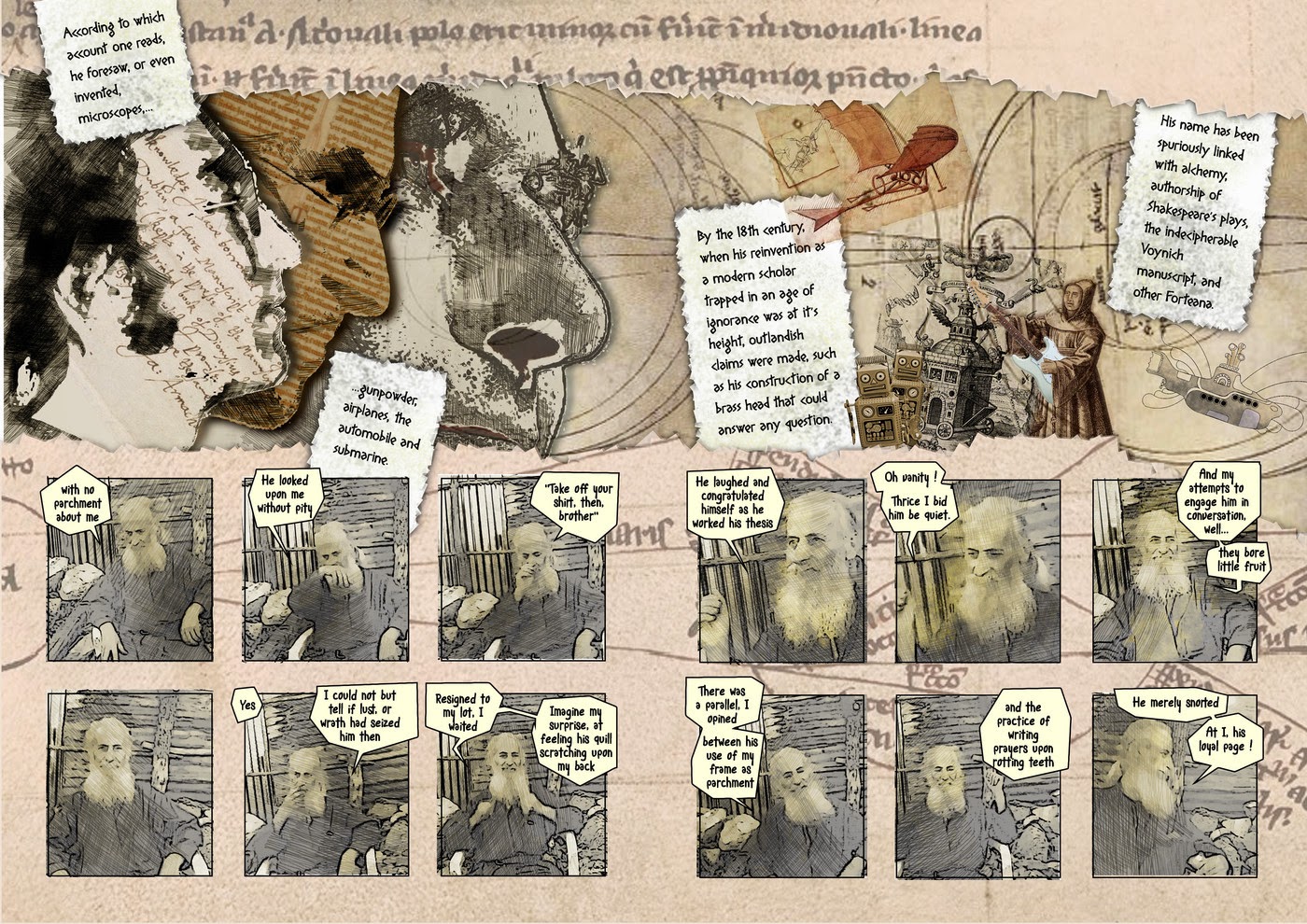
A Footnote in History
Based on an extended conversation with my son while he was studying for his GCSE history, discussing the history of medicine, as we walked across the Cotswolds one day. Individually, all of the events in here are factual, to the best of my knowledge, I've just woven them together.
This was a testing ground for a lot of the techniques that I'd like to use in the graphic novel I'll be improvising at LICAF in Kendal, October 18th this year. If you're attending the festival, do drop by on Saturday, and picture yourself in the place of the old bearded fellow on the bottom half of each page - and you too could become a footnote in comic-book history!
Monday, 15 September 2014
Planetary Dynamics
Digitally painted backgrounds for a 4-page strip about planetary physics (Tidal Locking in particular!)
Page 2 isn't ready yet (or, at least, I'm not happy with it!)
Thursday, 4 September 2014
Twelve Easy Pieces
When I'm not doing comics, I'm often found doing code. Here's an experiment that combines the two. I've cut out 42 roughly equal-sized panels from drawings that I've done, and randomly recombined them on top of a six panel script. Look at how the words and pictures dance together, and modify each other's meanings!
The drawings are rather rough. The script is hardly epic (yet!). But I'm already quite excited by the possibilities of this. So excited, in fact, that I'm breaking the usual schedule to post this right now!!
The internal repetition on the first one was a lucky accident. Both silent panels (I think these are important in comics storytelling in general) came out the same. Or the weeping muscular figure in variant #5, reprised in the ending of variant #11.
The drawings are rather rough. The script is hardly epic (yet!). But I'm already quite excited by the possibilities of this. So excited, in fact, that I'm breaking the usual schedule to post this right now!!
The internal repetition on the first one was a lucky accident. Both silent panels (I think these are important in comics storytelling in general) came out the same. Or the weeping muscular figure in variant #5, reprised in the ending of variant #11.
Labels:
abstraction,
adaptation,
cats,
digital,
formalism,
generated,
kata,
pitt pens,
repetition,
sketch
Subscribe to:
Posts (Atom)